
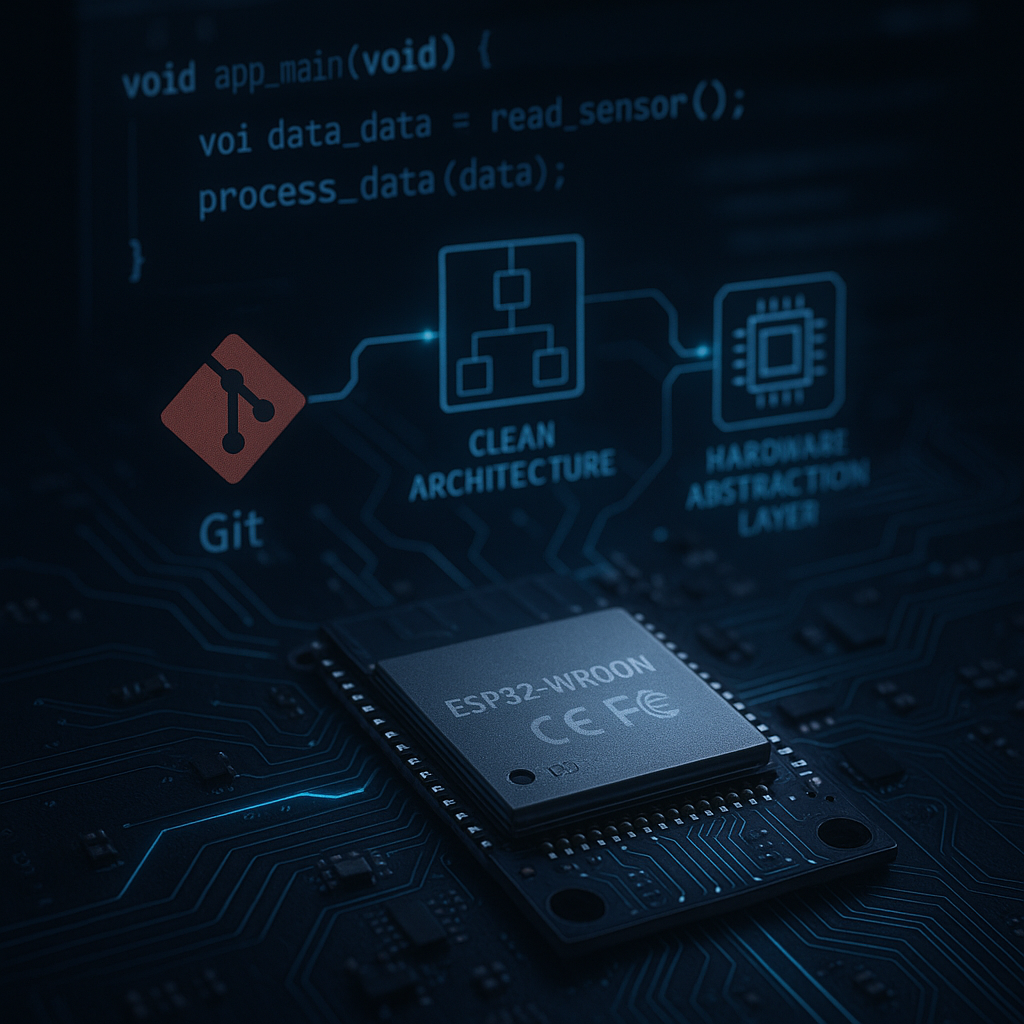
In January 2026, I led a two-day technical training specially tailored to the needs of the REMS development team. The goal was to accompany the transition from classic IDEs and microcontrollers to a modern, highly professional ecosystem around the ESP32 and VS Code.
Professionalism Beyond “Hello World”
In the embedded world, the focus is often on pure implementation, while the development process is neglected. In this training, I turned the tables: Instead of just explaining registers, we dealt with scalable firmware architectures.
A central pillar was the Professional Workflow. We analyzed deeply how to not only use the ESP-IDF Build System (CMake) but to master it. My goal was to show the participants how to break down a monolithic code block into clean, reusable components. This is the point where “tinkering” becomes real engineering.
Bridging the Gap: Embedded Meets Modern Software Engineering
A special highlight of the training was the integration of modern software con-terminisms into the embedded world:
- Modularisierung & Abstraktion: How do I write hardware drivers (HAL) that are so generic that they work in any future project via copy & paste (or better: via Git)?
- Git Mastering: We dealt intensively with Git Submodules and external repositories. For many developers, the interaction between a stable firmware and external dependencies is a challenge – we established clean workflows for this.
- Deep-Level Debugging: From JTAG/OpenOCD to the analysis of stack traces and core dumps directly in VS Code.
Data Management & Architecture
In the advanced modules, we discussed the storage of complex data sets. We experimented with how to integrate database engines as components into an ESP32 project and how to use file systems like LittleFS or NVS professionally for configuration management.
The team’s response was overwhelming. It is always inspiring to see how experienced engineers find new ways to make their projects cleaner, more modular and ultimately more maintainable. For me personally, this workshop was confirmation that professional software architecture is the most important lever for quality even on the smallest systems.