
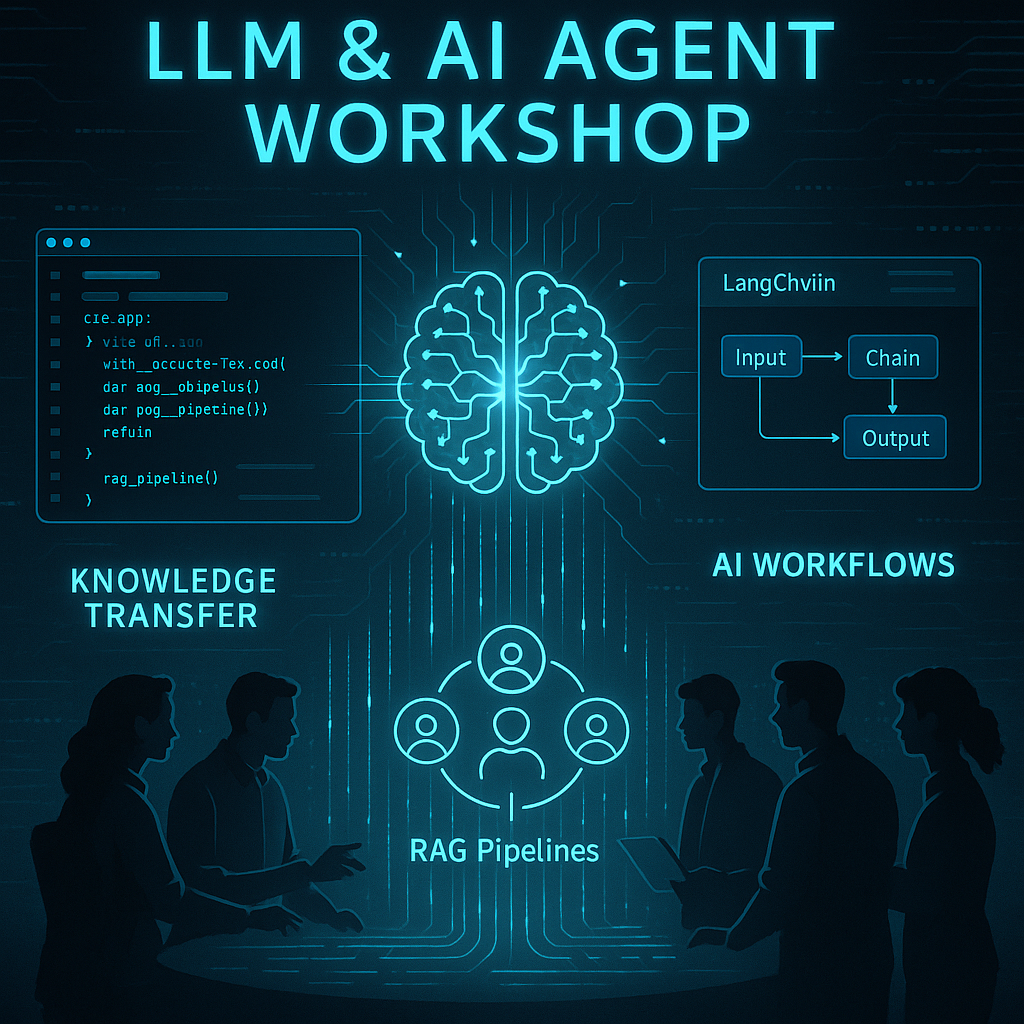
In my role as a mentor and technical advocate, I designed and led a two-day intensive training course in July 2025, aimed at making the potential of Large Language Models (LLMs) for professional developers.
Bridging Theory and Practice
For me, knowledge transfer is more than just reading out slides. The goal of the workshop was to turn participants from passive users into active creators of their own AI-supported workflows. The first day was dedicated to fundamental concepts: What actually happens under the hood of a transformer? How do I formulate prompts so that they deliver reproducible and high-quality results?
A focus was on integration into the daily workflow with VS Code. We analyzed how modern copilots function not only as “code completers” but as strategic partners in refactoring complex legacy systems and in architectural analysis.
Building the Future: From Chat Query to AI Agent
On the second day, we left the limits of classic chat interfaces behind. Together with LangChain, we explored the world of autonomous agents.
It was fascinating to observe how the participants realized that by using tools and memory, an LLM is suddenly able to solve complex problems independently – such as the automated analysis of log files or the creation of test suites from unstructured requirements. These “aha moments”, when the first own RAG pipeline (Retrieval-Augmented Generation) is up and running, are for me the confirmation of how important sound further training is in this rapid technological era.
The training ended with a lively discussion about ethics, security, and the future of software development, which once again underscored: AI does not replace the engineer, but the engineer with AI expertise will set new standards.