
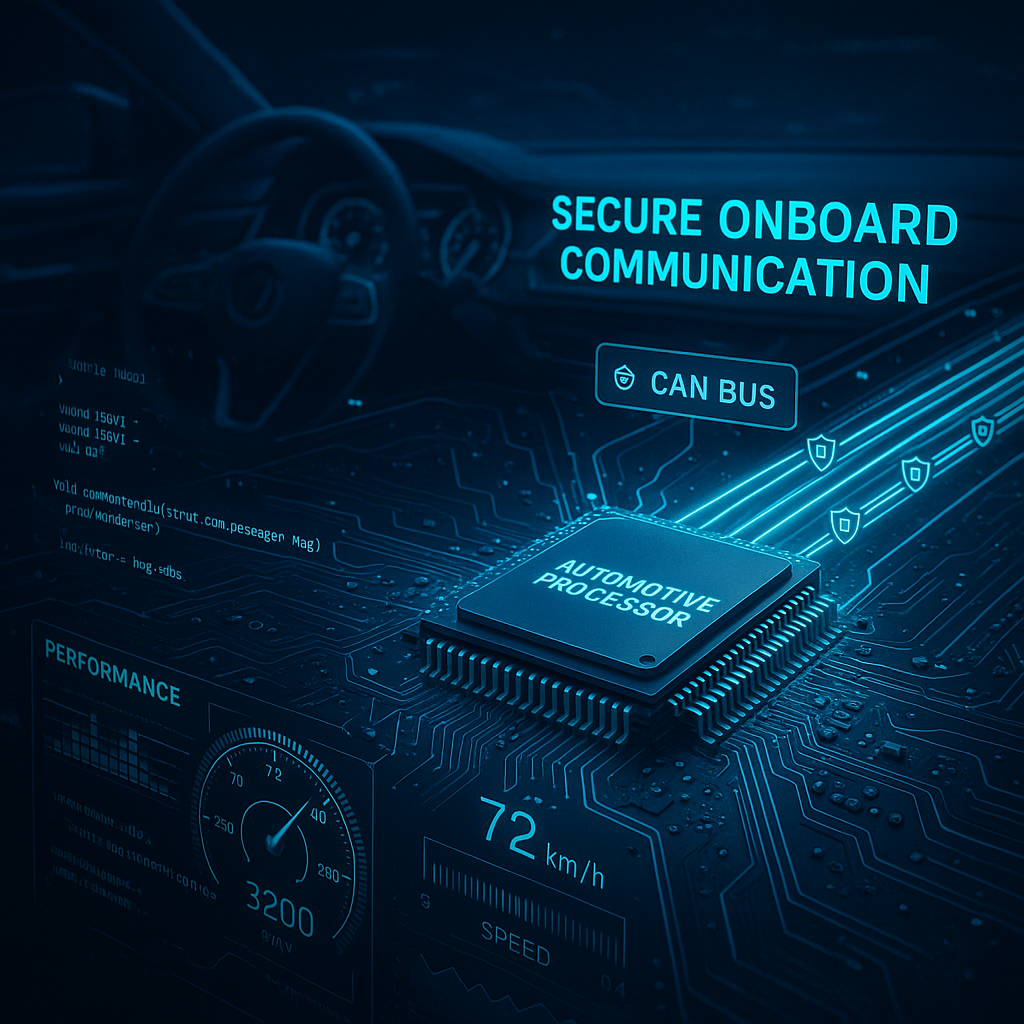
In this project, the TI Jacinto 7 was again used as the central hardware platform. The focus was on the implementation and securing of SecOC (Secure Onboard Communication) for E2E-encrypted CAN communication.
Simulation and Counterpart Development
Since the physical counterparts in the vehicle network were not yet available at the beginning of development, the entire bus communication had to be simulated. Vector CANoe was used for this. The corresponding SecOC counterparties were scripted using CAPL (Communication Access Programming Language) to model the correct behavior for encryption, signature verification, and freshness value management.
Performance Analysis and Overhead
A critical part of the project was the early execution of speed measurements. The goal was to make reliable estimates about:
- How many CAN messages can actually be encrypted under real conditions without critically influencing the bus load or latencies.
- What percentage of overhead is caused by the additional security headers and cryptographic calculation operations on the Jacinto 7.
This data was essential for further system design and the definition of security profiles in the vehicle.